Tuesday, November 10, 2026

On Tap Today

  • Borrow to build: Voters approved housing bonds in three states while rejecting zoning and environmental reform.

  • Shared space showdown: The lender that took over a Chicago hotel sues to stop an office-to-residential conversion upstairs.

  • Bay Area believers: A Florida firm just paid up for SF office space and wants more.

  • Office webinar: Join us Nov. 12 for a look at how owners are repositioning office portfolios heading into 2027. Register

Daily Market Snapshot
S&P 500 7,549.94 +173.08 (+2.35%)
FTSE Nareit All Equity REITs 854.21 +12.92 (+1.54%)
10-Year Treasury 4.88% +2 bp
SOFR 3.89% −3 bp
Data as of market close November 9, 2026. SOFR reflects the November 6 trade date.
The S&P 500 jumped 2.35 percent to 7,549.94 on Monday, its best day since April 8, as falling oil prices and a rebound in tech and industrial stocks clawed back much of last week's post-election selloff, even with Nvidia down more than 4 percent. All 11 sectors rose and the Dow added 1,104 points, though the S&P 500 still sits slightly below its Election Day close. The 10-year Treasury yield rose 2 basis points to 4.88 percent ahead of Tuesday's October CPI report, as Friday's hot payroll number kept December rate hike odds elevated and fixed-rate take-out and refi pricing under pressure. The FTSE Nareit All Equity REITs index climbed 1.54 percent to 854.21, recovering most of its Thursday and Friday losses, with data centers up 3.9 percent, lodging and industrial up more than 2.5 percent, and office REITs gaining 2 percent. SOFR slipped 3 basis points to 3.89 percent on the November 6 trade date, its lowest print since October 21, trimming floating-rate carry on bridge and construction loans.

Editor’s Pick

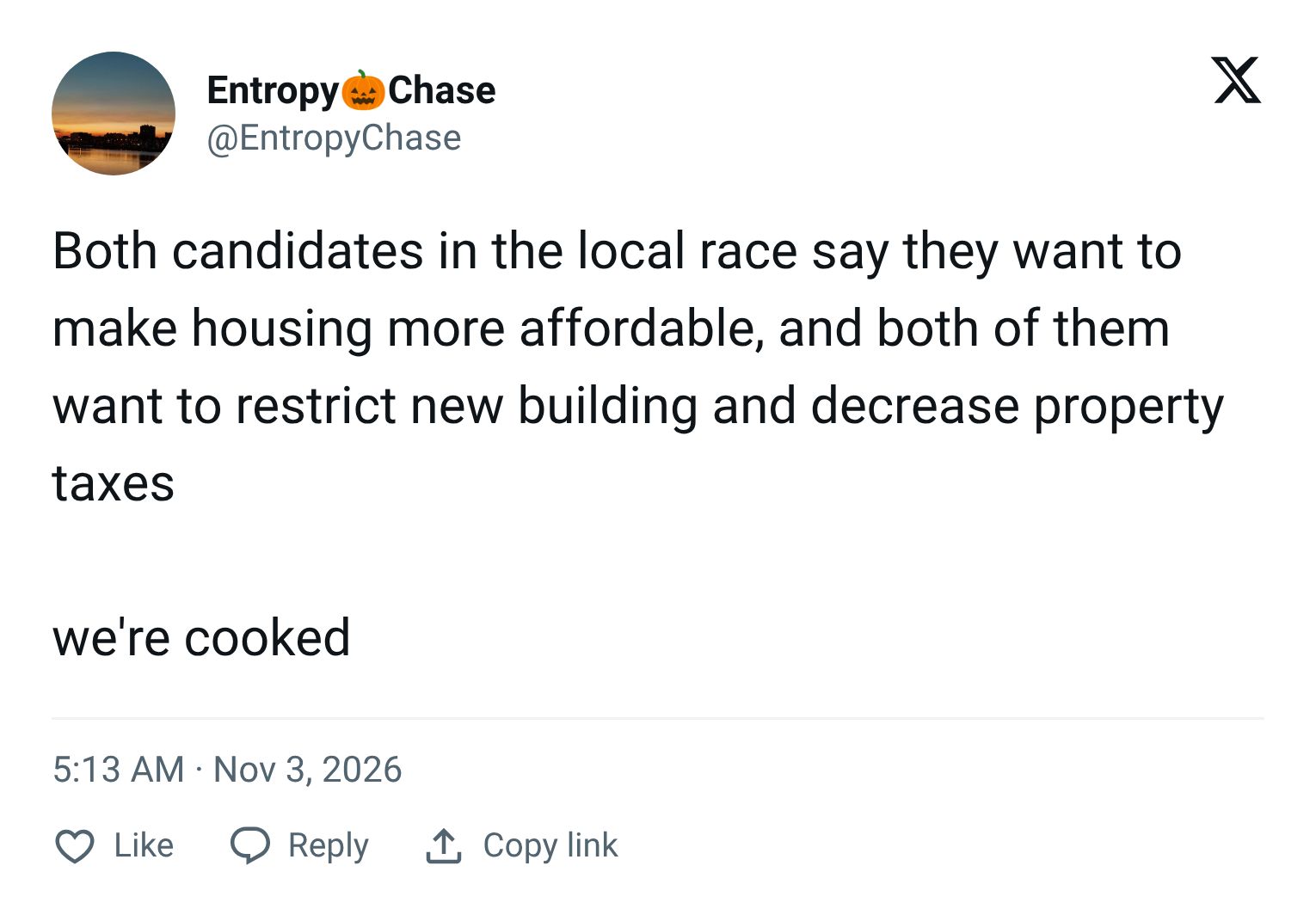
Voters across the country sent a clear message about housing affordability last week: they’re willing to spend billions to address the crisis, but they’re far less enthusiastic about changing the rules that make housing expensive to build. Every housing bond measure on the ballot passed, while both proposals to ease development restrictions failed. The results reveal a fundamental contradiction in how Americans want to solve the housing shortage.

California led the spending spree, approving billions in new housing bonds, while Rhode Island, Hawaii, and the city of Raleigh also backed housing investments. But California voters rejected a measure to scale back environmental review for housing, and Massachusetts voters turned down looser minimum lot-size rules. The distinction matters because financing more affordable housing does little to address the regulations that constrain supply in the first place.

There’s also a growing financial cost to the approach voters prefer. Municipal borrowing has surged to record levels, just as rising bond yields make financing more expensive. Governments are committing taxpayers to decades of debt payments while leaving many of the barriers to new construction intact. The election raises an uncomfortable question: Can America spend its way out of a housing shortage it remains unwilling to build its way out of?

Fast Take

Easement Dispute Stalls Office Conversion Above Chicago JW Marriott

A lender that foreclosed on the JW Marriott Chicago in 2022 has sued to halt an office-to-residential conversion of five floors at 208 South LaSalle Street, claiming the project violates a 2014 reciprocal easement agreement. The developer began demolition work in late October to prepare the conversion, which is part of the city's LaSalle Street Reimagined initiative. The hotel occupies the 12 floors below the office space being converted into apartments in the landmark building.
The lawsuit centers on a reciprocal easement agreement that requires either party to obtain consent before undertaking work that could materially affect the other. The hotel's owner argues the developer proceeded without obtaining that approval. A hearing in the case is scheduled for January 4, 2027.
The LaSalle Street Reimagined initiative launched after the pandemic emptied Loop office buildings, with city officials aiming to transform what they called an "office monoculture" into a mixed-use neighborhood. The Bellwether Residences, the first completed conversion under the program, opened in early September. The 208 South LaSalle dispute illustrates how easement agreements and shared infrastructure can complicate adaptive reuse projects even when municipal policy supports them.
 
Fast Take

Out-of-State Capital Returns to San Francisco's Office Market

Florida-based 1754 Properties closed on a six-story office building at 40 Jessie Street in late October for nearly $28 million, marking the firm's first San Francisco acquisition and first office purchase in a portfolio otherwise concentrated in Florida and Mexico hotels. The company partnered with Vander Capital Partners on the deal, which values the property roughly $10 million above the $17.6 million Long Market Property Partners paid Golden Gate University in 2023. Google occupies the entire building under a lease that runs through 2030, following its 2021 acquisition of previous tenant Fitbit. About 60% of the space is configured as lab area.
1754 Properties CEO Joe Smith said the firm plans to build a larger Bay Area office portfolio and is seeking local partners for additional deals. He cited the city's AI-driven leasing momentum and office vacancy falling below 30% as evidence the market has turned. Smith called current conditions "probably the best it's been in 12 years" and expects single-digit vacancy rates within four to five years. The firm is passing on hotel investments in San Francisco despite its specialty in that sector, citing high union concentration and labor costs.
San Francisco has drawn a wave of out-of-state buyers over the past year as AI growth has shifted investor sentiment. A Texas investor began acquiring Union Square properties in 2023, while East Coast investors launched Project Uris in the same neighborhood. Foreign capital entered the market this year with purchases of the Transamerica Pyramid and Ghirardelli Square, and a New York investor is set to buy a downtown retail property. Smith described the shift as a reversal of the prior five years, when capital flowed from California to Florida rather than the opposite direction.
Office Market Trends and Portfolio Strategies webinar
Free Live Webinar · Thursday, Nov. 12
Office Market Trends and Portfolio Strategies Heading Into 2027
1:00 PM ET / 10:00 AM PT
Office markets are still adjusting to shifting tenant demand, new workplace expectations, and changing investment conditions. Join us for a look at the trends shaping the office market heading into 2027 and how owners and asset managers are positioning their portfolios to perform.
✓ Evaluating asset performance and repositioning properties
✓ Adapting leasing strategies to shifting tenant demand
✓ How tenants are actually using office space, and what that means for layouts
Speakers
Peter Miscovich Peter Miscovich
Executive Managing Director, Global Future of Work Leader, JLL
Thierry Ondet Thierry Ondet
Managing Director, ROOM
Todd Burner Todd Burner
Chief Product Officer, Kastle Systems
Franco Faraudo Franco Faraudo
Editor and Co-Founder, Propmodo (Moderator)
Save My Spot →
Presented by ROOM   Kastle  

Overheard

Popular Articles

🗣
What real estate topic do you wish got more coverage?

Email [email protected] with a topic, a trend, or a question you keep running into, and we'll cover the best ones.

Please add our newsletter email, [email protected], to your contacts to make sure you don’t miss any updates.